
What Is RTP? Return to Player, Explained Properly
RTP is the single most quoted number in online slots, and also one of the most misunderstood. This guide explains exactly what it means, how it's calculated, and — using the Gates of Olympus family's own published figures — why the same headline percentage can hide more than one real-world number.
The Actual Definition
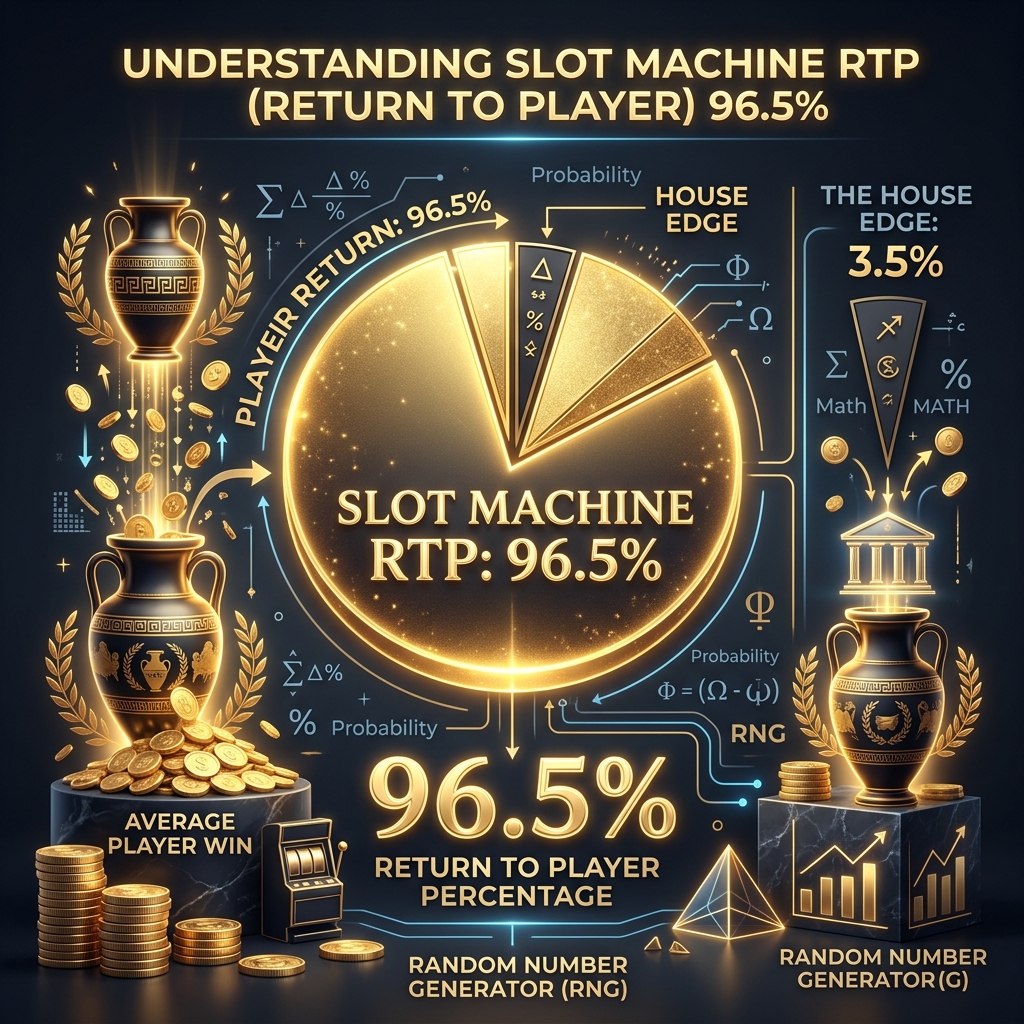
Return to Player (RTP) is the theoretical percentage of all money wagered on a slot that the game is mathematically designed to pay back to players, calculated across a very large number of spins — realistically millions, not a single session. A game with 96.50% RTP is designed so that, over that enormous sample, roughly £96.50 is returned for every £100 wagered in total across all players and all sessions combined. It is not a promise about your specific £100, your specific session, or your next ten spins. It's a statistical property of the game's underlying mathematics, verified before launch by independent testing laboratories.
How RTP Is Actually Calculated
A studio like Pragmatic Play builds the full probability model for a game — every symbol, every payout, every feature trigger chance — and runs it through simulation at massive scale to derive the theoretical long-run return. That model is then independently tested and certified by an accredited laboratory before the game can be licensed to operators in a regulated market. This is a mathematical property of the game's design, not a live, observable statistic tracked at your specific casino in real time — which is exactly why "the machine hasn't paid out in a while so it's due" is a fundamental misunderstanding of how the number works.
Why the Same Game Can Have Multiple RTP Figures
This is the detail that catches most players out, and it applies directly to every game reviewed on Gates Hub. Pragmatic Play licenses several certified RTP configurations for the Gates of Olympus family: a default of 96.50%, plus lower variants at 95.51% and 94.50% for the original and Gates of Olympus 1000. Individual operators choose which one to run, and that choice isn't always disclosed prominently in the game lobby. The number you see on a review site (including this one) reflects the studio's default or most commonly cited figure — not a guarantee for the exact operator you play at. The only reliable way to know your live figure: open the game's info panel (usually a small "i" icon or paytable button) at your chosen operator before you deposit.
| Game | Default RTP | Lower variants reported |
|---|---|---|
| Gates of Olympus | 96.50% | 95.51% / 94.50% |
| Gates of Olympus 1000 | 96.50% | 95.51% / 94.50% |
| Gates of Olympus Super Scatter | 96.50% | Not independently confirmed at time of writing |
RTP vs Volatility: Two Different Questions
RTP answers "how much does this game return on average, long-run?" It does not answer "how often will I win?" or "how big will my wins be?" — those questions are governed by volatility, a separate statistic describing how the return is distributed. All three Gates of Olympus games share the identical 96.50% published RTP, yet the original, 1000 and Super Scatter feel meaningfully different to play because their volatility characteristics differ — Super Scatter concentrates return into rarer, larger tiered payouts, while the original spreads it more evenly. See our dedicated Volatility Explained guide for the full picture of how these two numbers work together.
What RTP Cannot Tell You
- It cannot predict your specific session's outcome — you could lose steadily or win big regardless of the published figure.
- It does not mean a fixed percentage is returned on every individual spin or every individual player's account.
- It does not indicate how frequently you'll win — that's a volatility and hit-frequency question, not an RTP question.
- It is not adjusted or "corrected" over time by the casino to bring your personal results in line with the published average.
- It does not guarantee the figure quoted by a review site matches your specific operator's live configuration.
A Quick Sanity Check You Can Run Yourself
If you're ever unsure whether a figure quoted somewhere online is credible, cross-check it against at least two independent sources before trusting it — the studio's own published game page, plus one established independent slot-database listing. If both broadly agree (allowing for the studio's known variant range, e.g. 94.50%–96.50% for Gates of Olympus), the figure is probably reliable. If a source quotes something wildly outside that documented range with no explanation, treat it with real scepticism rather than assuming it's simply a more generous configuration.
How to Check Your Live RTP Before You Deposit
- Open the game at your chosen licensed operator, in either demo or real-money mode.
- Find the info icon — usually a small "i" symbol or a menu option near the paytable button.
- Look for "RTP" or "Return to Player" in the rules or info screen; reputable operators disclose it here.
- Compare it against the range published on the game's official page or on this site's specs table for the specific title you're playing.
- If it's not disclosed anywhere in the client, treat that as a trust signal worth weighing before you deposit.
A Worked Example: What 96.50% Actually Looks Like
Numbers like "96.50% RTP" are easy to read and hard to intuit. Here's a concrete way to think about it: imagine one million players each wager £100 total on Gates of Olympus over their lifetime playing the game, spread across however many sessions that takes. The theoretical model predicts that, summed across all one million players, roughly £96.5 million comes back out in total winnings against £100 million wagered in — a 3.5% house edge (£100 minus 96.50) distributed across that entire population. Crucially, that £96.5 million isn't spread evenly — most players will end their relationship with the game down some amount, a smaller number will be roughly break-even, and a much smaller number will land a disproportionately large win (helped along by orb multipliers or a strong free spins round) that pulls the population average back up to 96.5%. That's what "long-run average across an enormous sample" means in practice — it's a population-level statistic, not a promise about your £100 specifically.
RTP in the Wider Slot Industry
96.50% sits comfortably above what's commonly cited as the rough industry average (around 96%), which is one reason the Gates of Olympus family is frequently described as offering "solid" or "above-average" published returns compared to the broader online slots market. It's worth noting this isn't unusually generous by design — RTP figures across the regulated industry mostly cluster in a fairly narrow band (roughly 94–98%), and a 1-2 percentage point difference, while measurable over a very large sample, is a smaller practical factor for any individual session than volatility fit or how much you enjoy actually playing the game.
Frequently Asked Questions
What does RTP stand for?
Return to Player — the theoretical long-run percentage of all wagered money a slot is designed to pay back to players over a very large number of spins.
What is the RTP of Gates of Olympus?
96.50% is the published default across all three games in the family, though lower operator-selectable variants exist for each — always check the live figure at your specific operator.
Does a high RTP mean a game pays out more often?
Not necessarily. RTP is independent of volatility. A high-RTP, high-volatility game can still have long dry spells; RTP predicts long-run average return, not win frequency.
Why does RTP vary between operators for the same game?
Studios like Pragmatic Play license multiple certified RTP configurations for the same game, and individual operators choose which one to run — sometimes without prominent disclosure.
Is RTP the same as "house edge"?
They're related but inverse: house edge is roughly 100% minus RTP. A 96.50% RTP game has a theoretical house edge of about 3.5%.
Can I trust an operator that doesn't display RTP anywhere?
Reputable, licensed operators typically disclose RTP in the game's info panel. Its absence isn't automatically disqualifying, but it removes a useful trust signal, and we'd recommend checking a different operator if RTP transparency matters to your decision.
Is 96.50% a good RTP compared to the rest of the industry?
Yes, modestly — it sits above the commonly cited industry average of around 96%, though most regulated slots cluster within a fairly narrow band (roughly 94-98%), so the practical difference between a "good" and "average" RTP is smaller than volatility fit or overall enjoyment for most players.
Does RTP apply per player or across all players?
It's a population-level statistic calculated across an enormous number of spins from all players combined — not a guarantee that applies individually to your specific account or session.
See real RTP data in context
Every Gates Hub game review includes a sourced specs table with published RTP and evidence status.
Play Now — 18+ Gamble Responsibly